A Signature Accessory or a Rotating Color Palette?
Compare a signature accessory with a rotating color palette using clothes you own, then choose a style approach that feels recognizable without making mornings harder.
Should you repeat one recognizable accessory or vary colors to create a signature? A signature accessory or rotating color palette can make outfits feel intentional; the better fit depends on what you already wear and how much repetition you enjoy.
Start with your closet, not a shopping list. A scarf, watch, belt, bag, or pair of earrings may be enough to try either approach.
Start with your closet
Choose ordinary days rather than a special trip or a week full of events. Notice what you reach for now: comfortable jeans, a weather-ready jacket, and shoes you can wear all day. Your style idea should work with those familiar pieces.
Set aside several outfits you already wear, including a relaxed option and one that feels more polished. If one accessory works comfortably with most of them, repeating it may be easy. If your clothes span several colors or moods, a rotating palette may feel more natural.
Keep the experiment small. You are looking for a recognizable thread, not a reason to remake your wardrobe.
Notice what repeats
Before choosing, look for patterns you already enjoy. Perhaps you often wear a silver watch, or keep reaching for navy, cream, and rust. A style choice is easier to keep when it grows from genuine preference rather than a rule you have to remember.
Ask yourself:
- Which accessories do you reach for without much thought?
- Which colors appear in several favorite clothes?
- Does a familiar finishing touch feel reassuring or dull?
- Are your most-worn outfits mostly neutral, strongly colored, or mixed?
- Would choosing a color each morning feel playful or like another decision?
An accessory-led approach repeats an object; a palette-led approach repeats a family of colors while letting individual pieces change.
Try one accessory
Choose an item you own that feels comfortable and suits more than one kind of outfit. It might be a narrow leather belt, a silver chain, a canvas tote, a patterned scarf, or a simple watch. The best candidate is not necessarily the boldest one; it is the piece you are glad to wear often.
Pair it with several usual outfits and watch for practical friction. Does a scarf feel too warm under your coat? Does the belt work with the trousers you wear? Does the bag suit your commute and what you carry? A detail that stays at the back of a drawer is a poor match for your routine.
Imagine you own small gold hoops and wear them with a denim jacket, a black sweater, and a printed dress. If they feel comfortable with all three, the expected result is a recurring glint that links different outfits. If they catch on your headphones or clash with clothes you love, set them aside and try another candidate.
Repetition need not mean a uniform. You can keep one accessory as a visual anchor while changing clothes, shoes, or other jewelry.
Build a color palette
If variety makes getting dressed enjoyable, choose a small group of colors already present in your closet. Begin with a base color you wear often, then add colors found in your tops, layers, or accessories. Black, denim blue, and olive might work together; cream, brown, and burgundy could be another combination.
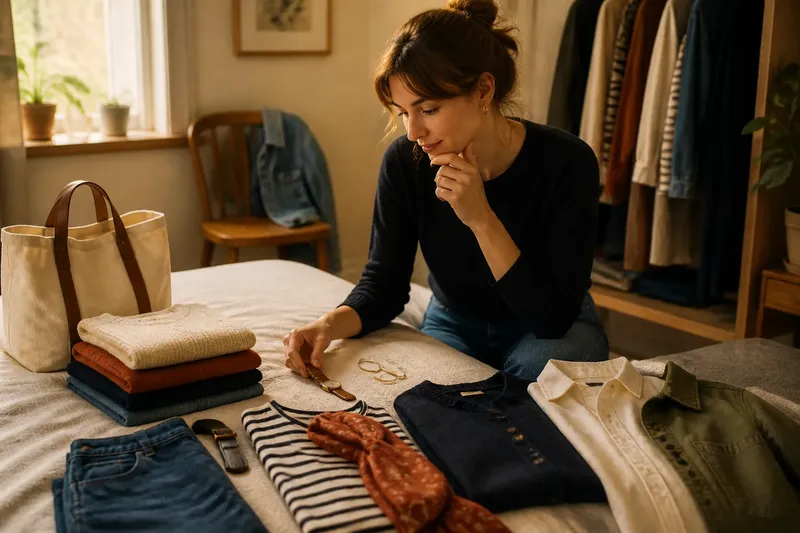
Lay a few outfits together on a bed or hang the pieces side by side. Look for colors that can meet in more than one outfit, not a perfect color-theory formula. A navy cardigan might work with a striped shirt one day and a rust scarf another, keeping the palette coherent without repeating one accessory.
Keep the palette flexible. If a color appears only in a garment you rarely wear, leave it out. If your closet is mostly neutral, texture or a subtle accent can do the work; you do not need to buy bright pieces to make the idea count.
Which approach fits your routine?
Which choice suits a small closet?
A signature accessory can make a compact set of clothes feel more distinct if the item works across your outfits. A rotating palette may suit you better if your existing clothes already share colors and you prefer changing combinations over repeating one object.
Can you combine both approaches?
Yes, but let one idea lead so the result feels intentional rather than over-planned. You might repeat a watch while changing colors, or keep a palette steady while varying your accessories.
What if you get bored quickly?
Try a palette, or choose an accessory you can wear in different ways, such as a scarf tied at your neck or on a bag. Leave room to change details without abandoning the larger idea.
Do you need to buy anything?
No. Begin with what you own and treat a missing item as useful information, not a shopping prompt. If the approach seems possible only after several purchases, simplify it until it works with your current closet.
Make the choice visible
For a short trial, choose one accessory to repeat or a small palette to vary across outfits. Make a note on your phone of what you wore and how getting dressed felt: easy, pleasing, repetitive, or awkward with a particular garment. Brief notes are easier to use than reconstructing the whole stretch from memory.
Imagine you own a canvas tote that works with a denim jacket and a black sweater, but you dislike wearing the same necklace every day. You try the tote with those outfits and note that it feels useful, then choose navy, cream, and rust for a few combinations. If the tote feels comfortable and color choices stay simple, the result points toward a palette with the tote as an occasional anchor; if choosing colors feels tiring, repeating the tote can lead instead.
Keep what works
You can revise the experiment rather than naming one approach the winner. Keep a favorite accessory for workdays and use a rotating palette on weekends, or repeat one color family while changing your bag or jewelry. The point is to make a choice that feels like yours, not to obey a style rule.
A signature accessory or rotating color palette should make familiar clothes easier to wear with intention. Keep the part that feels comfortable and expressive, and drop anything that turns getting dressed into a chore.