A No-Buy Month Without Turning It Into a Test
A no-buy month can clarify which purchases feel useful or automatic. Set a fitting boundary, plan exceptions, and review what you learn without scoring yourself.
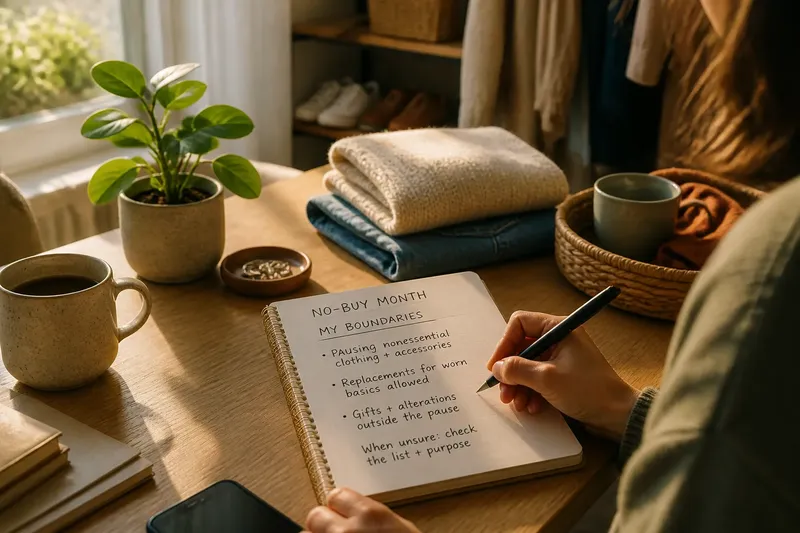
What would you stop buying for a month to understand a habit, rather than prove your willpower? A no-buy month works best when its boundary reflects your actual life: what you are pausing, which exceptions you expect, and what you hope to notice.
You could pause impulse clothing purchases while leaving books and gifts alone, or skip discretionary shopping across several categories. Neither choice is more virtuous; the useful one gives you a clear observation without making ordinary needs feel like rule-breaking.
Choose A Scope
Start with a purchase pattern you want to understand. A crowded bathroom shelf might point to skincare backups; browsing shopping apps after work might point to a recurring occasion rather than a particular product category.
Choose among three approaches:
- One-category pause: Set aside one area, such as decorative home goods, skincare extras, or casual clothing. If the question concerns that category, keep the pause there; if the pattern crosses categories, consider an occasion-based or broader boundary.
- Occasion-based pause: Avoid purchases prompted by a particular situation, such as browsing when bored or adding small treats to an online order. If the cue is clear, pause that occasion; if it is not, choose a category you can identify more easily.
- Broad discretionary pause: Pause nonessential purchases across several areas and name practical exceptions in advance. If you want to observe optional shopping across daily life, this may fit; if edge cases would create too much friction, narrow the scope.
Scope determines what you can learn and how many decisions you will face. A narrow boundary gives you a close look at one pattern; a broad one includes more kinds of purchases but calls for clearer exceptions.
Write The Boundaries
Before the pause begins, write a short policy in plain language. Name what is included, what is outside the pause, and what you will do when a case is unclear; a note on your phone is enough.
For example: “I’m pausing nonessential clothing and accessories; replacements for worn-out basics are allowed; gifts and alterations are outside the pause.” That distinguishes a spontaneous extra from a practical replacement more clearly than “I won’t shop.”
Use these checks to make the boundary workable:
- Check whether an item is used up, broken, or needed for an existing commitment; if it is, allow a practical replacement, and if it is still usable, leave it paused or save it to reconsider.
- Check whether a consumable is a routine replenishment or a new product to try; if it is a regular staple, allow the replenishment if your boundary permits it, and if it is a trial, keep it paused.
- Check whether a purchase is tied to a social occasion, such as a gift or shared plan; if you named that occasion as an exception, take part, and if you did not, choose an option that fits the boundary or revise it deliberately.
- Check whether a secondhand item or swap still counts as acquiring something under your rule; if it does, treat it like the corresponding purchase, and if it does not, record the distinction so the boundary stays clear.
- Check whether a subscription, appointment, or purchase was arranged before the pause; if it was, follow the plan you wrote down, and if it was not, apply the boundary you set for new commitments.
- Check whether an unclear item serves a specific practical need; if it does, consider a proportionate exception, and if the reason is mainly a passing urge, save the link and revisit it later.
These are prompts, not universal rules. Someone pausing skincare might allow sunscreen as a practical need and pause a new face mask; another person’s routine may call for a different line.
Plan For Exceptions
An exception is not a loophole when you name it in advance and keep it connected to the purpose. Replacing unusable shoes or buying a required work item can address a real constraint; “I feel I deserve it” is harder to apply consistently.
Say you are pausing new kitchen gadgets because a drawer is full of rarely used tools. Halfway through the month, your kettle stops working, and you rely on it each morning; your written rule allows practical replacements. You replace the kettle, leave a specialty milk frother in the online cart, and note the distinction: the replacement restores a routine, while the frother is an additional purchase. The observable result is a clearer choice, not a perfect record.
For items that are not urgent, save the product link, write down what prompted the desire, or add it to a “Revisit later” note. A small pause between wanting and purchasing can give you room to decide without declaring that you can never buy the item.
Notice The Moment
When an urge to buy appears, record enough context to recognize it. A quick note might read, “looked at new mugs after reorganizing the cupboard” or “wanted a sweater while getting dressed for a cold commute.”
Notice whether the item would replace something, solve a specific inconvenience, or appeal because it is new. You can also note what prompted the urge: a recommendation, a friend’s message, a store display, or a routine browse.
Then notice what happens after the urge passes. You might forget the item, borrow something similar, use what you already have, or still want it because it addresses a real gap; each response offers different information.
Keep observation separate from self-criticism. “I browsed after a tiring day” gives you context; “I have no discipline” does not tell you what to change. If the pause makes you anxious or interferes with ordinary needs, narrow it or stop.
Which Questions Help?
Is a category pause or broad pause better?
A category pause fits a question about one area, such as why you keep adding clothing. A broad pause covers more optional shopping but can bring more edge cases to decide.
Should essentials count as buying?
Decide beforehand how your rule treats routine replenishments and replacements. Handle needs related to health, work, caregiving, or another real obligation sensibly, and consult a qualified professional if a health or safety decision requires it.
What if you buy something during the pause?
Note what happened and whether it fit a boundary or exception you had already set. Clarify the rule for the remaining days, or stop if the pause no longer serves you; there is no score to repair.
How do you choose a boundary?
Choose a category when your question concerns one kind of purchase, or an occasion when a recurring cue is the pattern you want to notice. Use a broader boundary only if seeing across categories is worth its extra decisions.
Review Without Scoring
At the end, read your notes as clues about fit. Which items faded from mind, which stayed relevant, and which moments repeatedly led to browsing? Look for patterns that might inform a future choice, not evidence that you passed or failed.
Ask yourself:
- Which boundary was easy to understand in an ordinary moment?
- Which exception came up, and did it reflect a practical need or a vague impulse?
- What did you use, borrow, repair, or do instead?
- Did the pause make shopping feel less automatic, or add unwanted friction?
- Is there one category or occasion you want to handle differently next time?
Imagine your notes say that browsing for home goods often began while you were avoiding an unfinished household task. That does not prove the browsing caused the delay or that the desire was meaningless. It may give you a useful choice: keep shopping out of that moment, try a different break, or leave the pattern alone.
You might return to your usual buying habits, keep one boundary that feels helpful, or try a narrower pause later. If you revisit a saved item, consider why you wanted it and whether it still fits your needs; time passing does not compel you to buy or reject it.
A no-buy month is most useful when it leaves room for real life. Keep a boundary that makes decisions clearer, and let it go if it starts taking more attention than the question you hoped to answer.